I inherited the job of Director of Studies (DoS) in a summer school after the person doing the role left mid-way through the summer. Inducting new students, placement testing, and ultimately creating cohort groups was one of the first tasks I had to get to grips with.
I had a brief explanation on how this should be done by the outgoing DoS but really, I was thrown in at the deep end. The testing process included a spoken and written sample from every student and a grammar test. The grammar test was ineffectual and even if it was, it seemed clear that enough evidence could be gathered by listening and interacting with students and comparing this with any written sample they had submitted.
As a side note, I kept, and still keep, the grammar scores with student records even though it can be wildly inaccurate, e.g., a spoken and written sample suggest a student is approximately pre-intermediate but the grammar score tell us they are closer to being advanced. By using the grammar score in our level calculations, it would erroneously inflate their abilities, leading to errors in which levelled group they might be placed. Sometimes, however, grammar scores are requested by students and group leaders for their own administrative purposes when they get back home. It is important to explain any incongruity so there is clarity on which data is more useful for our purposes- a basic user of English is not proficient no matter what a piece of data suggests.

Once students had been tested and the three scores gathered – speaking, writing, and grammar, I was able to start the process of putting them into class groups. With scores written on each test, I would lay the papers down on a long table to start the process of creating class groups by looking at each score and making a judgement call on where each student should be placed on a spectrum of beginner to advanced. This was a frustrating process which took an inordinate amount of time, not to mention the need to add students into the mix who had already been in class for at least a week. However, at some point, students, new and old, would materialise into class groups. However, it was clear this wasn’t the best method – stacking test papers one on top of another – it was impossible to get an overview of test scores.
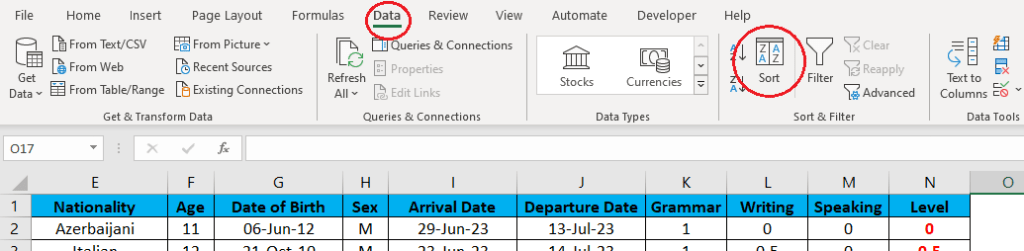
It took me two years to find out that a spreadsheet was the best tool for the job and by using a basic sort function, I could do the same task, only quicker and better. To put this in context, the process from finishing placement testing to having class lists ready could take more than eight hours when done by hand. By using a spreadsheet, it took half that time. In later years, I became a dab hand at it and was able to class six hundred students in around an hour.
In most summer school contexts, student data is usually uploaded to a central database before they arrive. If we have names, dates of birth, and nationalities, we can start adding test scores. The key thing with using a spreadsheet to create class groups is you have visuals on all scores and quite complicated sort processes can be done in an instant using the built-in sort function.
Spreadsheets interpret numbers so it’s essential to use a number score. I would always use a score system from 0 – 5* but any whole number or fraction would also work. Once there are numerical scores for each student, we should try and consolidate test scores into a level:
- Add a student’s scores together, e.g., 2 for writing and 1.5 for speaking = 3.5.
- Divide the number by 2, e.g. 3.5/2=1.75.
- Round up the score to .5, e.g., 1.75 rounded up becomes 2, which is the overall level.
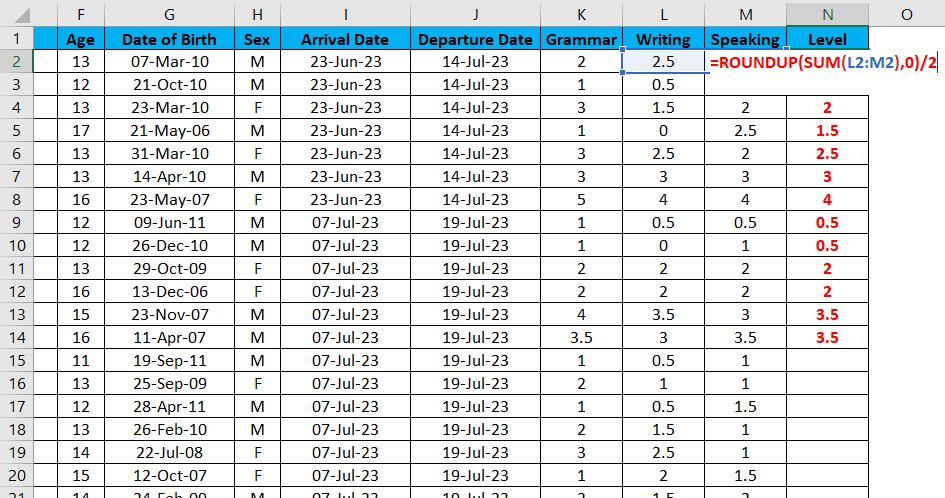
Expressed as a spreadsheet function: =ROUNDUP(SUM(#CellWithWritingScore:#CellWithSpeakingScore),0)/2
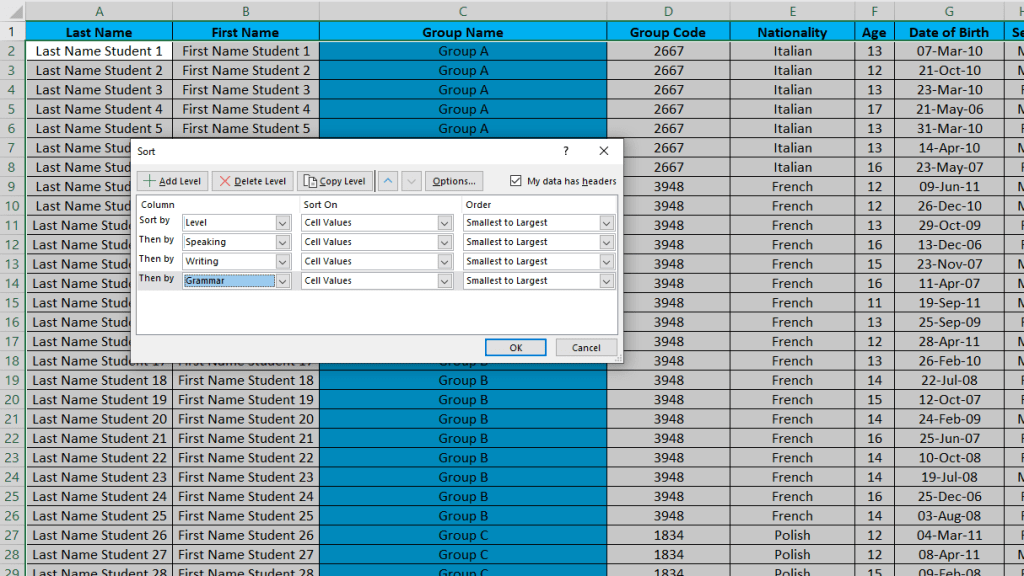

The process doesn’t finish here. We need to be mindful of age; we cannot have 12-year-old and 17-year-old students studying together. Re-sort the data within a particular level band by age, then level, speaking, writing, etc., and try and group students within 3-4 years of each other with similar levels. If you have to level place students with a 4-year age gap, be careful with young learners- there will be a distinct difference between an 11-year-old and a 14-year-old in a group than there would be between a 14-year-old and a 17-year-old in another group.
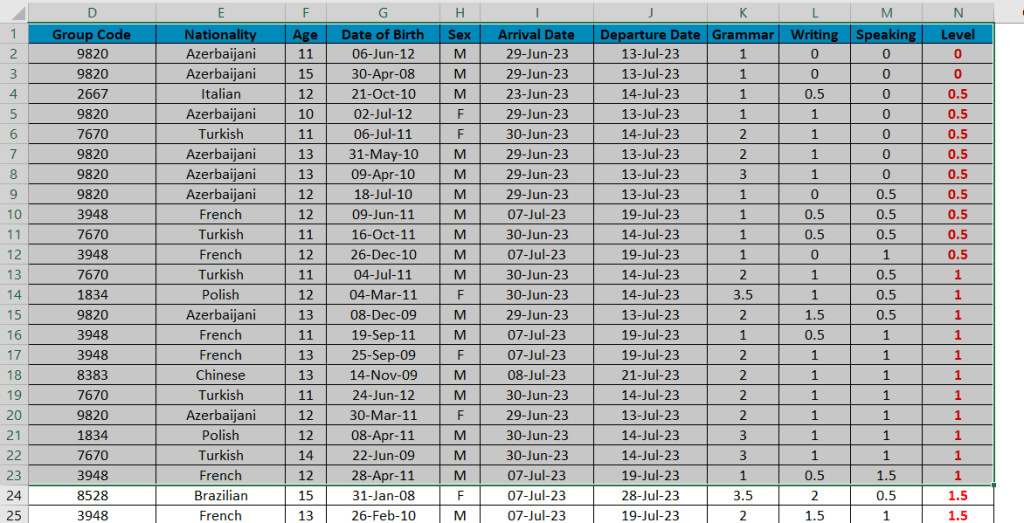
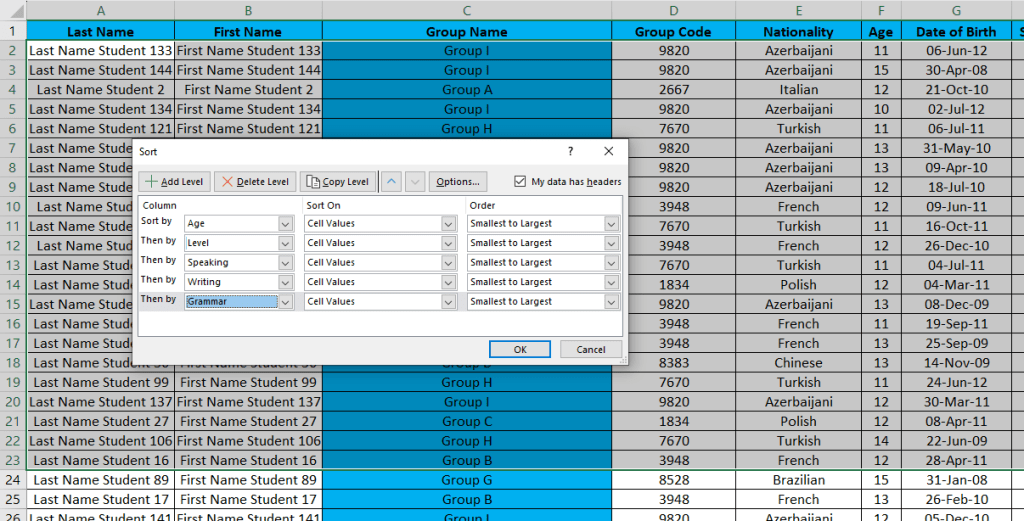
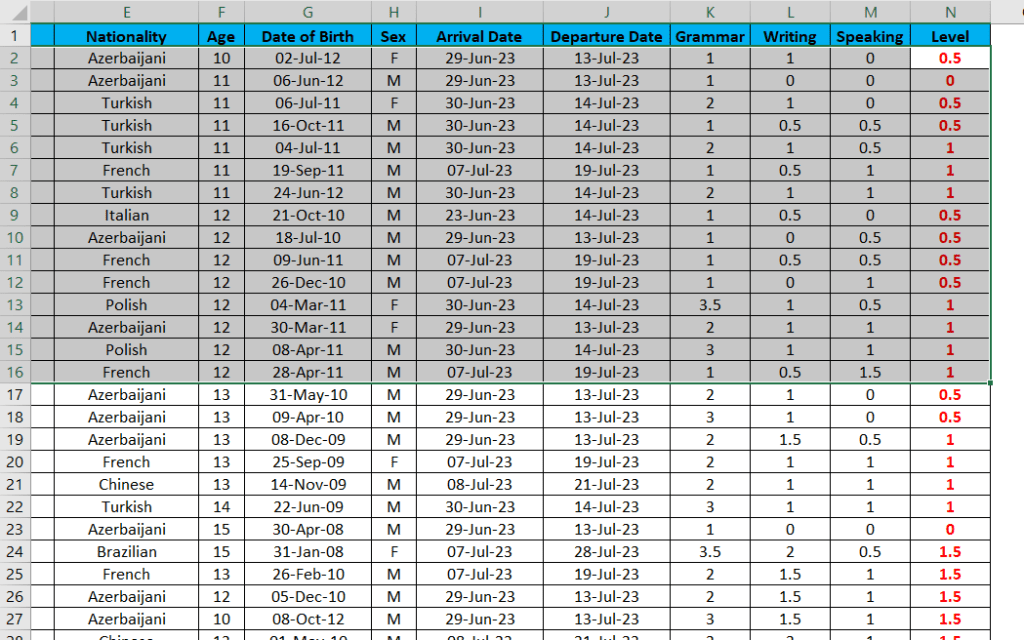
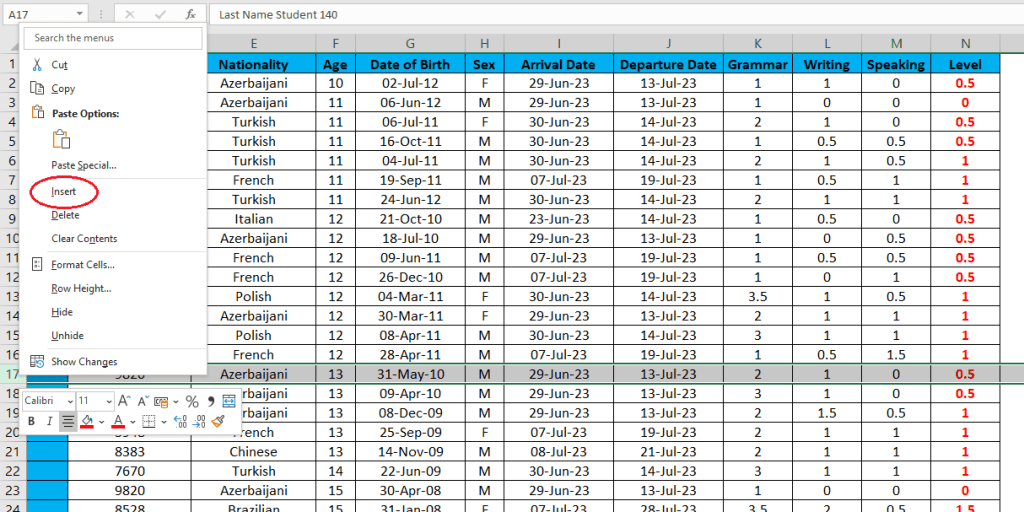

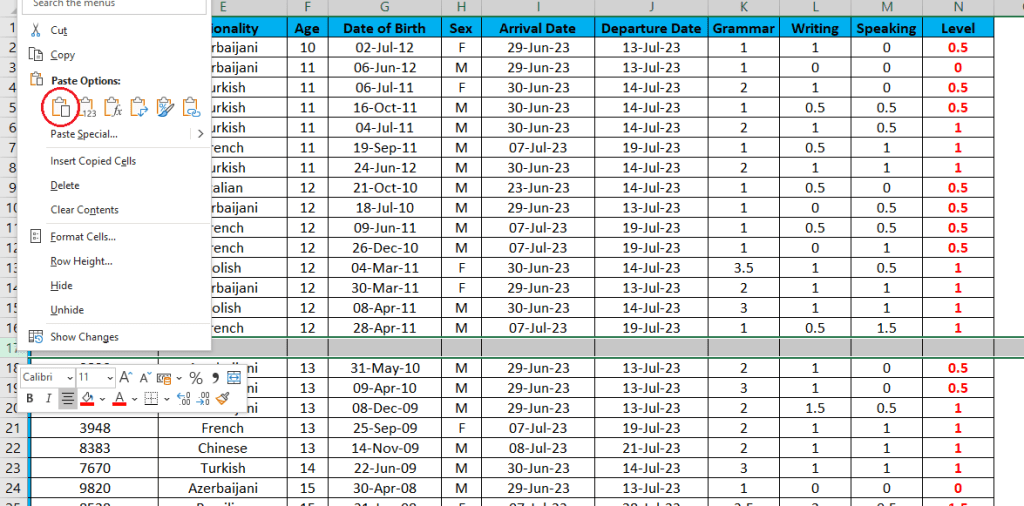
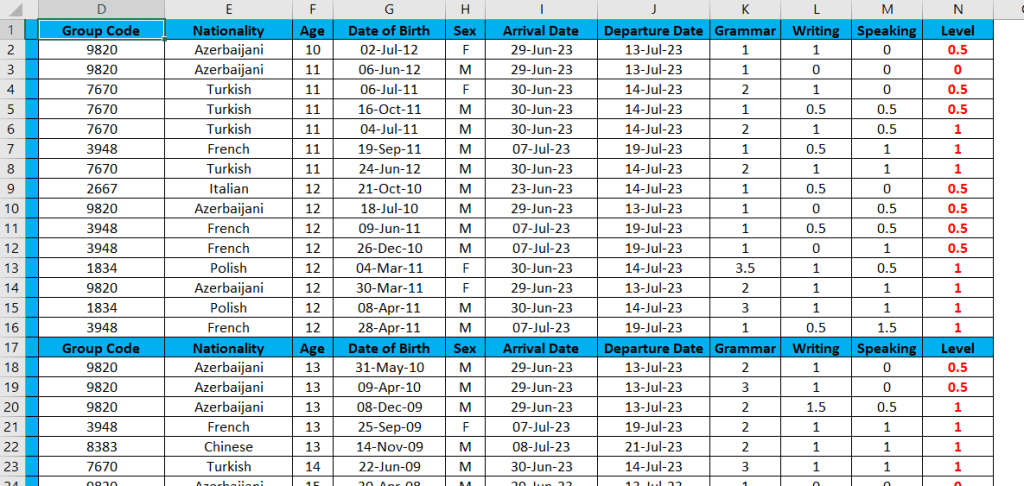

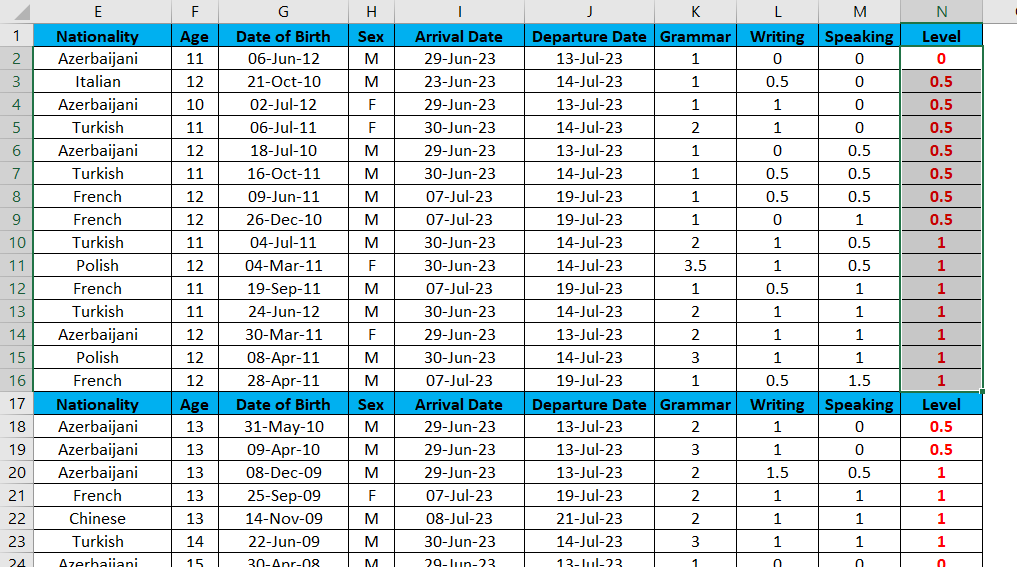
Once these considerations have been met, there will still be a need to tweak the class groups. It might be the case there are special considerations which dictate why a student has to be placed in a particular cohort or why moving a few students from one group to another will create a better nationality mix, etc. Also, try not to fill every class group to its capacity, there should be some room for a few students to move groups if and when there is a necessity. At the point where you are happy with the student mix, copy and paste the student groups into registers for teachers.
I think over the years, I have become less hung up on level and more on other factors which make for a better student experience. It is not to say we should not be mindful of ability, but if two inseparable friends, with a marked difference in their communication, were to be placed in different groups, it might not only spoil their experience but become a welfare issue. If we keep them together, one friend will support the other and in turn, the teacher will support them both. We already avoid placing older teenagers with younger children even if it’s at the expense of level and still make it work – I once placed a 17-year-old beginner in an advanced group because the students in the beginner group were 12 years old. Unlike in a year-round context, there is a necessity to compromise more in summer school and it’s not necessarily a bad thing. When students are happy, teachers are happy, and the whole thing functions. Just make sure you oil the squeaky wheels.

* Score system: 0 = beginner; 0.5 = beginner/elementary; 1 = elementary; 1.5 = elementary/pre-intermediate; 2 = pre-intermediate; 2.5 = pre-intermediate/intermediate; 3 = intermediate; 3.5 = intermediate/upper-intermediate; 4 = upper-intermediate; 4.5 = upper-intermediate/advanced; 5 = advanced.
Working in summer school? I’ve been doing it longer than I care to remember! Click here for further ideas and burnt offerings! Summer school ideas
You have 136 students and 10 teachers. Want to work out how many should go in each group? Have a look at this tool: Class ratio calculator
Do your teachers share classes? Do you have an odd number of teachers? This tool might help: Three-way split generator
Need a board game to compliment that activity you are doing this afternoon? Look no further than here: Games and board games
 EFL Summer School
[…] This blog post is the second part on classing students in summer school. If you would like to understand more about how to manually class students using a spreadsheet, click here: Summer school: Classing […]
LikeLike
[…] starting point is this blog post, Summer school: Classing where I discuss my experiences on how to manually class students using a spreadsheet. The second […]
LikeLike